
Pest Inspections in Newcastle & the Hunter
A pest inspection is a visual assessment of the accessible parts of a property for evidence of timber pests — termites, borers and fungal decay — and for the conditions that make timber pest activity more likely.
- Written report
- Visual, non-invasive
- Hunter & Central Coast
From $275
Get your written quote
Step 1 of 2
Takes 30 seconds. No obligation.
off the next report
Subsequent report offer
25% off your next pre-purchase report
If the findings in your pre-purchase pest and building report mean you decide not to proceed with the purchase, your next pre-purchase pest and building report is discounted by 25%.
Conditions & eligibility
- Applies to subsequent pre-purchase pest and building reports only.
- Available where you do not proceed with the purchase based on the findings of the initial report.
- The subsequent report must be booked and completed within three months of the first pre-purchase pest and building inspection.
- The discount does not apply to stand-alone termite, building or pest-proofing services.
- Offer may be withdrawn or varied at any time before a booking is confirmed in writing.
What this inspection actually is.
It is deliberately different from a general pest spray. A spray treats insects you can see. A timber pest inspection looks for the damage you cannot see, in the places timber pests actually work: the subfloor, the roof void, the base of walls, the fence line and anywhere timber meets soil.
The inspection is non-invasive. We do not cut holes, remove linings or disturb the building. That limits what can be observed, and we say so plainly in the report rather than implying the property is clear.
- Written report with findings
- Photographed where useful
- Price confirmed in writing
- Locally based inspector
Photographed where it matters.
Roof voids, subfloors, wet areas and access points. These are ordinary findings from our own inspections — documented rather than described.


What you notice is the smallest part of the problem.
Property defects behave like an iceberg. The part above the surface is a stain, a crack or a musty smell. The part below is where the cost actually lives — and it is only found by looking systematically.
Above the waterline
What buyers ask us about- Damage that does not announce itself
- Moisture is the invitation
- Previous activity, unknown history
- Timber in contact with soil
Below the waterline — what an inspection looks for
Damage that does not announce itself
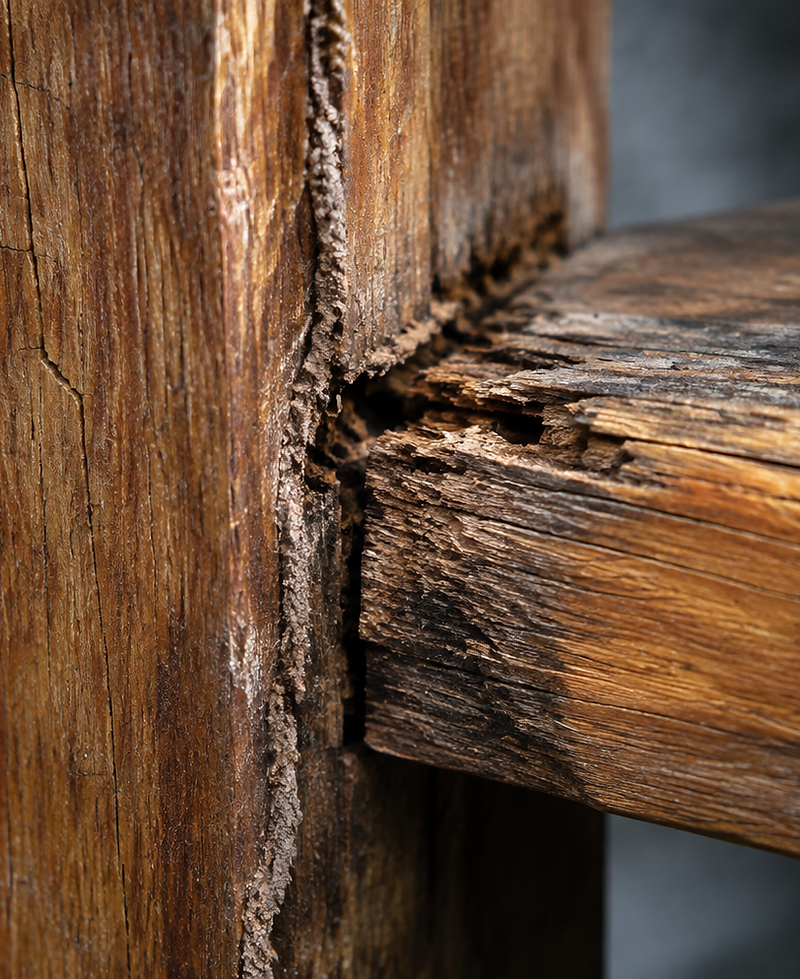
Termites eat timber from the inside out. A skirting board, door frame or bearer can look sound until it is tapped, probed or replaced — which is why buyers are often surprised by how much a report finds in a home that presented well.
Moisture is the invitation
Leaking taps, blocked downpipes, garden beds against the slab and unventilated subfloors all raise moisture. That is the single most common condition we record as conducive to timber pest activity.
Previous activity, unknown history
Old mud tubes, treated timbers, drill holes and bait stations all tell a story. Without documentation, buyers cannot tell whether past activity was treated or simply painted over.
Timber in contact with soil
Fences, sleepers, pergolas, garden edging and decking that touch the ground give termites a bridge into the structure. It is easy to spot once you are looking for it, and easy to miss on a walk-through.
What we look at, and why each area matters.
Every area below is assessed where it can be safely and lawfully accessed. Anything that cannot be reached is listed in the report, with the reason, rather than glossed over.
Interior
Accessible skirtings, architraves, door and window frames, cupboards, flooring, and any visible signs of movement, staining or hollowing.
Subfloor
Where safely accessible: bearers, joists, piers, ant caps, ventilation, moisture readings and timber-to-ground contact.
Roof void
Where safely accessible: trusses, battens, sarking, insulation contact points and evidence of moisture or pest activity.
Exterior
Base of walls, weep holes, eaves, fascia, downpipes, cladding, verandah posts and steps.
Grounds
Fences, retaining walls, sleepers, garden beds, trees and stumps within the immediate area, plus drainage fall against the building.
Conducive conditions
Anything that raises the likelihood of future activity: bridging, poor ventilation, plumbing leaks, debris in the subfloor and drainage defects.
Where this fits in the wider picture.
Inspections work best when the scope matches the property. These are the assessments we carry out across the Hunter and Central Coast.
From $275
ViewingPest Inspections
Understand visible evidence of timber pest activity and the conditions that support it, within the agreed inspection scope.
Current pageFrom $275
Termite Inspections
Professional termite inspection services with documented findings and clear recommendations, priced from $275.
Explore serviceFrom $330
Building Inspections
Assess accessible building elements and identify significant defects and relevant maintenance concerns within the inspection scope.
Explore serviceFrom $550
Pre-Purchase Pest & Building Inspections
Combine building and timber pest inspections to obtain a more complete understanding of a property's condition before you commit.
Explore serviceFrom $275
Pest-Proofing Inspections
Identify potential pest entry points, vulnerable building areas and opportunities to improve pest exclusion.
Explore serviceFrom $275
Pest-Proofing Works
Practical pest exclusion recommendations and quotation-based works where offered and suitable.
Explore serviceSix steps, no surprises.
From the first enquiry to a written report — what happens at each step, and what you receive at the end of it.
Tell us about your property
Share the address, property type, size and anything you already know — contract dates, access notes, or concerns from an open home.
Choose your inspection
Building, timber pest, or both combined. We will tell you if a different scope would serve you better before you book.
Confirm scope and access
We confirm what will and will not be inspected, how the property will be accessed, and the confirmed price in writing.
On-site assessment
A visual, non-invasive inspection of the safely accessible areas within that scope, documented as we go.
Receive written findings
A written report setting out what was observed, where it was observed, and what it may mean for you.
Understand next steps
Recommendations are ranked by significance, with any item that needs a licensed trade or specialist called out clearly.
Condition information you can act on.
Independent, locally based and documented in writing — so the findings hold up when you take them to your solicitor, your agent or your builder.
- Understand what is visible before you commit to a property
- Get the moisture and drainage issues on record in writing
- Use documented findings in your pre-purchase negotiations
- Establish a baseline for ongoing timber pest management
- Know which observations warrant a licensed specialist
Who should book
- Buyers under contract or preparing to make an offer
- Owners of older or timber-framed homes due for a periodic check
- Owners who have found termite evidence or mud tubes
- Investors reviewing a portfolio property
- Sellers who want to disclose known issues with documentation
If you delay
The cost of finding out later.
- Undetected termite damage can affect structural timbers before any surface sign appears.
- Conducive conditions left unmanaged tend to worsen rather than resolve on their own.
- Renovation or landscaping work can cover access points and evidence.
- Repair costs are often discovered after settlement, when the previous owner has no obligation to contribute.
- Insurance generally does not cover termite damage to a building.
These are general risks of proceeding without an inspection, not predictions about any particular property.
Reviews from property owners.
Reviews appear here only when they can be matched to the original source. Nothing on this page is written by us.
Each time I was impressed with his thorough and comprehensive inspection of the property. He has a wealth of experience and knowledge and happy to go the extra mile to explain property issues.
Colin Johnston
Building inspection · Google
I found Gary online and required a B&P within a short time frame. Not only did he provide a detailed report and was able to clarify concerns I had, but gave me strong advice which would've saved me a massive headache down the track…
Aakash Jey
Building & pest inspection · Google
My partner and I had Gary do a pre-purchase pest and building inspection, and he was fantastic. He took the time to explain everything clearly.
mikaela L
Pre-purchase pest & building · Google
Where we inspect.
Pest Inspections are available across Newcastle, Lake Macquarie, Maitland, Hunter Valley, Port Stephens & Central Coast. Tell us the suburb and we will confirm availability and any travel before you book.
Newcastle, Lake Macquarie, Maitland, the Hunter Valley, Port Stephens and the Central Coast. Rural and regional properties are quoted with travel included up front, never added afterwards.
Availability
Same-day service available where capacity allows. Inspections by appointment, and a written price is confirmed before the inspection proceeds.
- Coverage
- 6 regions, 70+ suburbs
- Starting price
- From $275
Tools, guides and articles on this topic.
Free to use, and written by the same inspector who carries out the work.
Calculators & tools
Information guides
Articles
Pest Inspections — common questions
Still unsure whether this is the right inspection for your situation?
0412 686 581In practice they usually refer to the same thing: a visual timber pest inspection covering termites, borers and fungal decay. If you have been told you need a 'pest inspection' before purchase, confirm whether a combined building and pest inspection is what is actually required — it usually is.
No. Stored goods, furniture and floor coverings limit access, and the report will note where that occurred. Clearing the subfloor and roof void access before the inspection improves coverage.
It is documented with its location and significance, and the report recommends the next step — treatment and management options assessed by a licensed timber pest specialist. Treatment is not carried out as part of the inspection itself; it is arranged through Accurate Pest Control, the pest management arm of the same business.
Frequency depends on the property and its risk factors. Your report will state a recommended re-inspection interval based on what was observed, rather than a fixed number for every home.
Yes, but the report will state clearly that the subfloor could not be accessed and that concealed conditions could not be assessed.
Before you commit to the property, know what you're buying.
Findings, locations and prioritised recommendations in a written report — with the scope and confirmed price agreed in writing before the inspection.